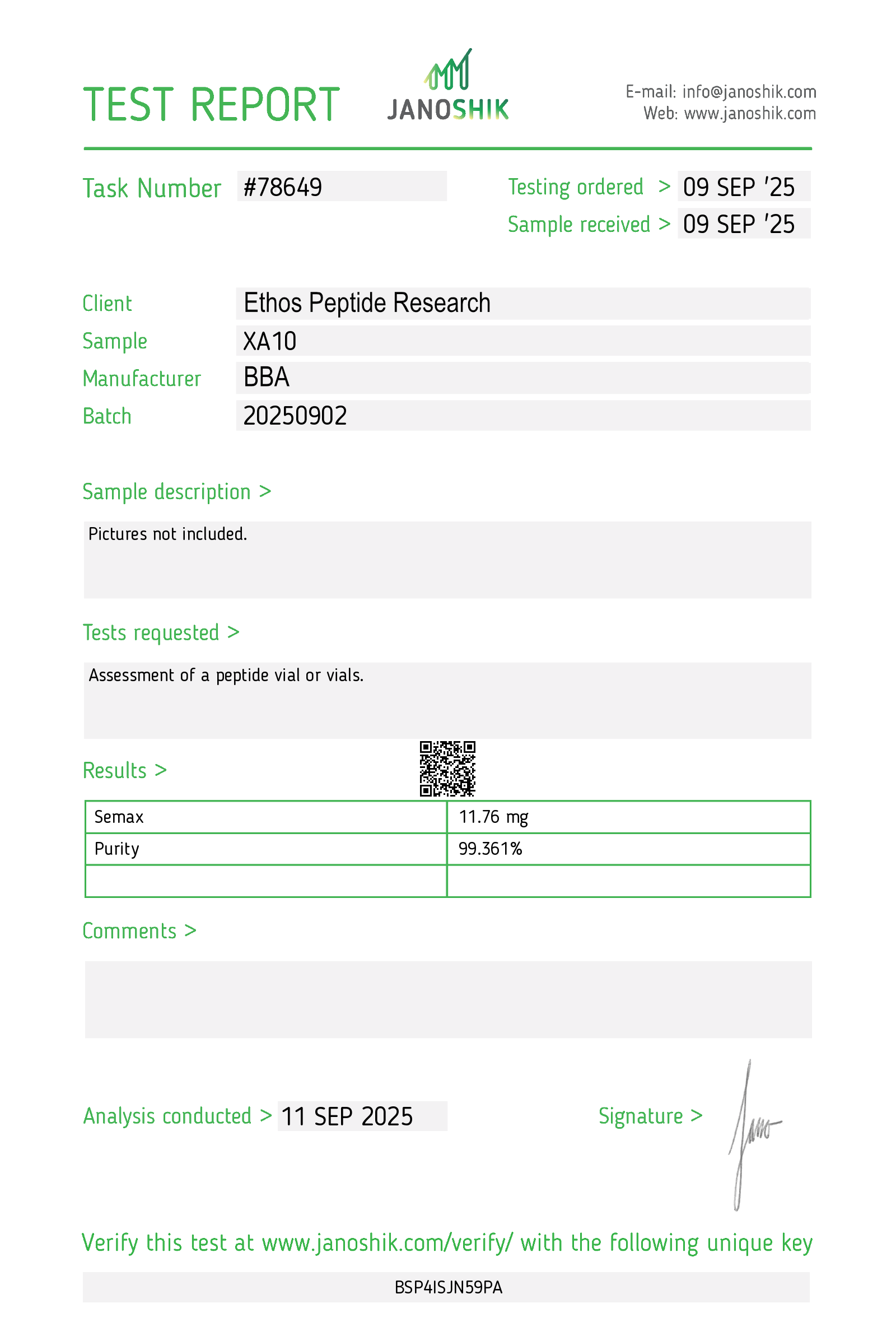


Evaluate a research peptide supplier by following the evidence from the seller’s identity to the exact material and its lot-specific records. Ask what each result measures, who issued it and what remains unverified. These ten checks are a practical purchasing framework, not a validated score or a supplier ranking. Published analytical studies explain why a certificate alone should not end the review (quality-evaluation study).
Can you identify the seller and the official channels?
Record the exact trading name, website and contact route you intend to use. Check that the enquiry, listing and order record point to the same organization. If a search result introduces another domain or a similar name, resolve that difference before relying on its documents. This is a practical identity check, not proof of laboratory quality.
Is the material specified beyond an informal name?
Ask for an unambiguous compound designation, including any fragment or modification relevant to the listing. In a study of synthetic quorum-sensing peptides, structural analysis showed why the main chromatographic peak could not automatically be assumed to be the requested peptide. That finding concerns the study’s materials, not an allegation about any named current vendor (primary study).
Does the report match the lot you are reviewing?
Put the listing, vial label and report together. Match the lot identifier and named material rather than accepting a certificate for a similar item. If the report predates the displayed batch or uses a different identifier, ask for an explanation. Keep the question open until the supplier provides a record that addresses the actual material.
Can you trace the document to its issuer?
Look for the issuing laboratory, report reference, date and complete document rather than a cropped result. Where verification is available, use the issuer’s own contact details or validation route. Record who commissioned the work and who selected the sample as separate questions. Do not assume that a laboratory logo establishes either fact.
Are the methods and measurement scope stated?
Ask which measurement produced each reported result and what was included in its scope. Choules and colleagues used NMR to identify an undeclared component in two custom peptide samples that routine chromatographic purity measurements had not disclosed. The example shows a method-specific limitation, not a conclusion that every laboratory method is unreliable (primary investigation).
Are purity and measured content kept separate?
Retain the original units and measurement labels. The NMR investigation distinguished supplier-reported HPLC-UV percentages from mass-related compositional measurements. Those values were not interchangeable descriptions of the same quantity. Ask for clarification before using one number to answer a different analytical question (published analysis).
Are additional constituents and form details declared?
Ask what the stated material specification includes beyond the peptide name, such as the documented salt form or other constituents. The same NMR study identified mannitol in two examined peptide materials, while a separate reference peptide was used for comparison. It does not establish that undeclared constituents are present in every research peptide (original paper).
Are storage statements tied to relevant evidence?
Read storage and shipping information alongside the material specification, without converting a general statement into a stability guarantee. A study comparing four hIAPP samples from three sources examined differences in aggregation measurements, including observations within 24 hours. Those in vitro findings are not universal shipping limits for other peptides (primary study).
Can you keep a usable version of the evidence?
Save the report reference, access date, selected listing and correspondence explaining any discrepancy. If a certificate is replaced or corrected, retain the relationship between the earlier and later versions. Your review should make clear which document informed the purchasing decision. A changing webpage should not leave the laboratory record without its original context.
Does the supplier answer limits without making personal-use claims?
Ask a specific unanswered question and assess whether the reply provides evidence, acknowledges uncertainty or merely repeats a slogan. Keep laboratory-research purchasing separate from requests for advice on personal use. This checklist does not establish regulatory classification, clinical suitability or permission for human or veterinary use, even when every requested document is available.
What the evidence actually shows
Quorum-sensing peptide evaluation: a 2015 analytical study examined 98 synthetic peptides, including linear and cyclic materials. Endpoints included chromatographic purity and impurity/identity assignments. Only 43 met the requested purity specification in that investigation. An overall study duration and independent replicate count were not stated; 98 is the peptide set, not a count of vendors or people (Verbeke and colleagues).
NMR composition investigation: the report examined unexpected composition in DR and DRVYI peptide samples and used DRVY as a reference. Endpoints included molecular identification and quantitative composition. The paper provides instrument-acquisition times, but those are not an overall study duration. This limited material set should not be turned into a market-wide prevalence estimate (Choules and colleagues).
hIAPP source comparison: four samples from three sources were examined in an in vitro aggregation model using fluorescence, capillary electrophoresis and mass spectrometry. The abstract includes observations of fibril formation within 24 hours, not a general shelf-life study. Its results concern hIAPP under those experimental conditions, not every peptide or supplier (Berardet and colleagues).
How this relates to research materials
Apply the same questions to the ETHOS US research catalogue. ETHOS uses “8X tested” to mean eight distinct tests before shipment, with batch COAs searchable in the public portal. That statement should not be expanded into an invented list of assays or a guarantee about an unmeasured property.
Use our COA reading guide for report fields and the HPLC and mass spectrometry comparison for measurement distinctions. Keep the material’s documented storage requirements, lot label and handling history together. Request evidence that addresses the particular uncertainty rather than assuming a broad testing claim answers it.
Frequently asked questions
Is this a ranking of peptide suppliers?
No. It is a ten-question review framework, not a validated scoring system or an endorsement of a supplier.
Is a high purity percentage enough?
Read it with the method and scope. The NMR investigation illustrates why one measurement need not describe every constituent.
Do the studies test ETHOS batches?
They are cited for their analytical questions and limitations, not as tests or certifications of ETHOS inventory. Use the relevant lot documents.
What if a key question remains unanswered?
Record the missing evidence and request clarification before reaching a conclusion. Do not replace an absent result with an assumption.
Research use only. ETHOS materials are for laboratory research, not human or veterinary use. This article concerns documentation and analytical evidence, not product effects or advice on personal use.
Frequently asked questions
Is this a ranking of peptide suppliers?
No. It is a ten-question review framework, not a validated scoring system or an endorsement of a supplier.
Is a high purity percentage enough?
Read it with the method and scope. The NMR investigation illustrates why one measurement need not describe every constituent.
Do the studies test ETHOS batches?
They are cited for their analytical questions and limitations, not as tests or certifications of ETHOS inventory. Use the relevant lot documents.
What if a key question remains unanswered?
Record the missing evidence and request clarification before reaching a conclusion. Do not replace an absent result with an assumption.