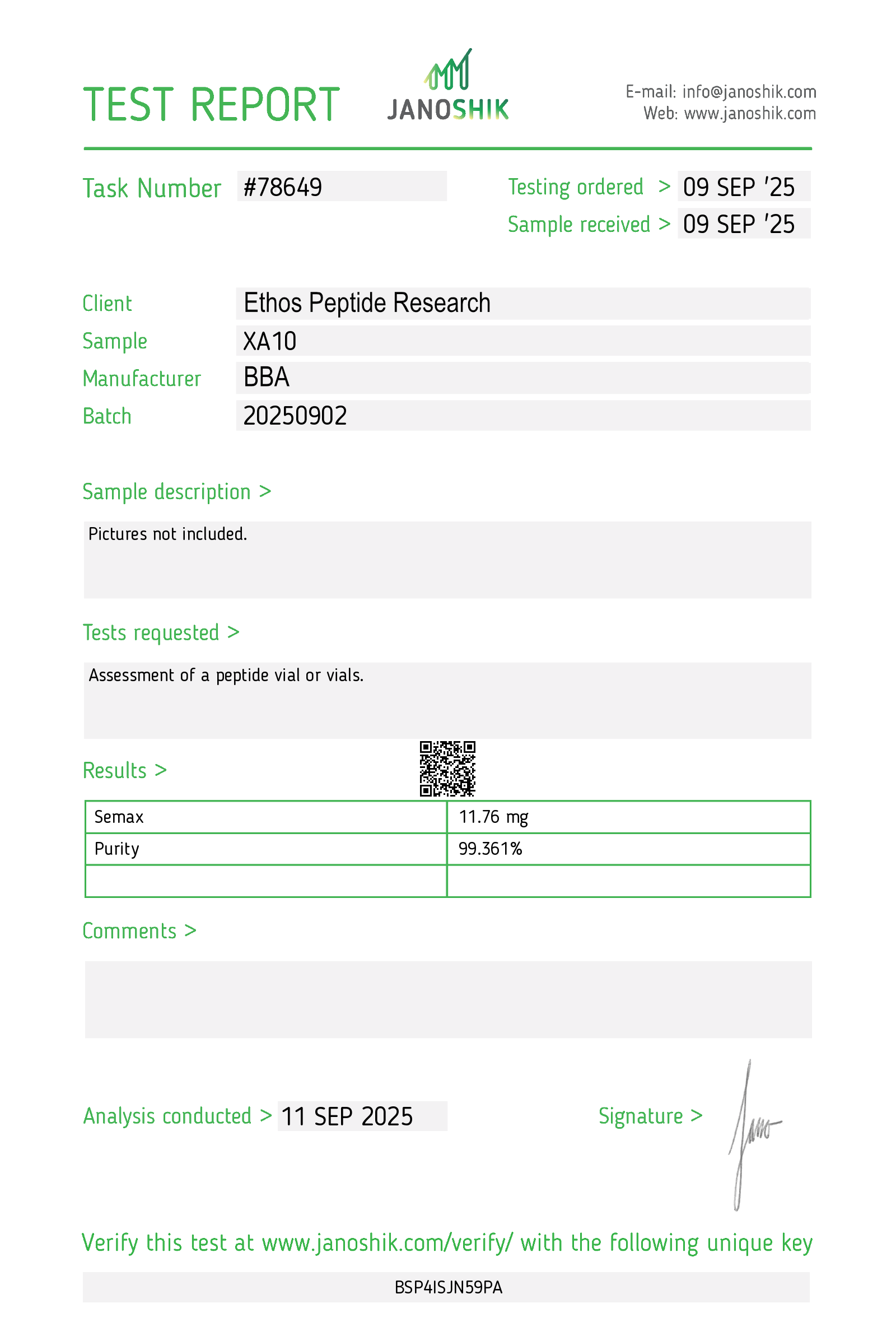


At ETHOS, “8X tested” means eight distinct tests before a batch ships, not eight repeats of one measurement. It is a statement about the testing process, not a promise of a biological outcome. To understand a particular batch, match its lot number to its certificate of analysis and read the documented results rather than relying on the shorthand alone.
What does the number eight actually describe?
Our standard is eight different tests for every batch before shipment, with batch COAs searchable by lot number. The useful distinction is between the number of different checks and the number of times a particular measurement is repeated. The ETHOS quality page and public COA portal are the places to connect that statement to product documentation.
Do not read “8X” as eight laboratories, eight sampled vials, or eight identical instrument runs. None of those meanings follows from the phrase. If a research project requires a particular measurement, ask for the relevant batch documentation and check whether that measurement is recorded. A general testing statement should never substitute for an unanswered analytical question.
Why are different measurements useful?
A measurement has a defined question behind it. In peptide analysis, confirming identity and examining an impurity profile are related tasks, but they are not the same task. An FDA presentation on comparative peptide studies discusses complementary methods based on different separation principles and additional work to identify individual peaks.
That example comes from generic-drug development. It explains why complementary evidence can matter, but it does not establish the composition of ETHOS’s testing panel. The FDA presentation is not an audit of our business and should not be presented as one. Our batch reports, rather than a borrowed regulatory example, are the relevant records for a supplied lot.
Is repeating a measurement the same as adding another test?
No. For the purpose of the ETHOS statement, eight different tests means different checks, not a count of repeated readings. When reviewing any report, keep the test name, sample count, and number of repeats in separate fields. That simple habit makes it easier to see what a document actually records without inflating one number into another.
Ask a precise question when the wording is unclear: “Which distinct measurements are documented for this lot?” That is more useful than assuming a prominent number answers everything. If a report has several pages, keep the pages together so its results, dates, sample labels, and laboratory details are not separated from one another.
What the evidence actually shows
Online-sample analytical study: Ashraf and colleagues attempted purchases from six online vendors; three vials were delivered for analysis. The laboratory work examined sample quality, including measured content and purity. It was a product-testing snapshot, not a long-term biological experiment. The market surveillance covered July to September 2023, with purchases in August and September. See the 2024 primary publication.
The authors reported differences between documentation and laboratory measurements. The three delivered samples cannot describe the entire market, and the study did not test an ETHOS batch. Its relevance here is the distinction between a claim on a label and evidence generated by testing a particular sample. Those limits are important when reading the original study.
FDA impurity-characterization research: an FDA report describes an analytical investigation of five marketed calcitonin salmon products that identified more than 120 peptide impurities. The reported endpoints included impurity masses and charge states. The page is part of a fiscal-years 2013–2017 research report; it does not specify a separate follow-up duration for this experiment. See the FDA research account.
Methodology context: the September 2022 FDA presentation discusses comparative peptide impurity profiles and complementary analytical methods. It is a methods presentation, not a clinical trial with a participant count. It is included to explain analytical reasoning, not to assign those methods to ETHOS or imply a regulatory endorsement.
How do you connect a testing statement to your vial?
Start with the lot number printed on the label. Search that number in the ETHOS public COA portal, then compare the compound name and report details with the material you received. Keep the matching report with your laboratory records. A report for a different lot should not silently become the record for yours.
Next, read the results as individual entries. Note the result, units, method information, and any stated limitations. If a required field is missing, ask for it rather than filling the gap from a different product page. Our earlier article on how to read a peptide COA explains the document fields in more detail.
How this relates to research materials
For an item in the ETHOS individual research peptides catalogue, distinguish three records: the listing identifies the offered material, the batch report records analytical observations, and a research paper describes a separate experiment. Keeping those records distinct avoids turning documentation into an unsupported product-effect claim.
Record storage requirements and handling history alongside the batch report. Follow the requirements documented for the material; do not infer a universal expiry date from the testing slogan. Where stability over time is the question, look for evidence that actually addresses time, rather than assuming a single test date answers it.
What should you ask when something is unclear?
Send the product name and lot number with the question. Specify whether you need help locating a report, interpreting its units, identifying a listed test, or resolving a mismatch between documents. That keeps the question tied to a traceable record rather than an abstract discussion of quality.
We do not publish a guessed list of eight assays to fill gaps in a report. The exact documented scope belongs with the relevant batch information. “8X tested” is a useful starting point, but the report is where a researcher should look for the details needed for a particular laboratory question.
Frequently asked questions
Does 8X tested mean eight repeats?
No. ETHOS uses the phrase to mean eight distinct tests before a batch ships, not eight repeats of one measurement.
Does the phrase identify every assay?
No. Do not infer a panel from the shorthand. Read the lot’s documentation and request any missing detail needed for your research.
Where can I find the report for my batch?
Search the lot number from the vial label in the ETHOS public COA portal and check that the report matches your material.
Is testing evidence of a biological outcome?
No. Analytical documentation and a biological study answer different questions. ETHOS materials are supplied for laboratory research only.
Research use only. ETHOS products are not for human or veterinary use. This article explains documentation and published analytical research, not advice on use.
Frequently asked questions
Does 8X tested mean eight repeats?
No. ETHOS uses the phrase to mean eight distinct tests before a batch ships, not eight repeats of one measurement.
Does the phrase identify every assay?
No. Do not infer a panel from the shorthand. Read the lot's documentation and request any missing detail needed for your research.
Where can I find the report for my batch?
Search the lot number from the vial label in the ETHOS public COA portal and check that the report matches your material.
Is testing evidence of a biological outcome?
No. Analytical documentation and a biological study answer different questions. ETHOS materials are supplied for laboratory research only.