

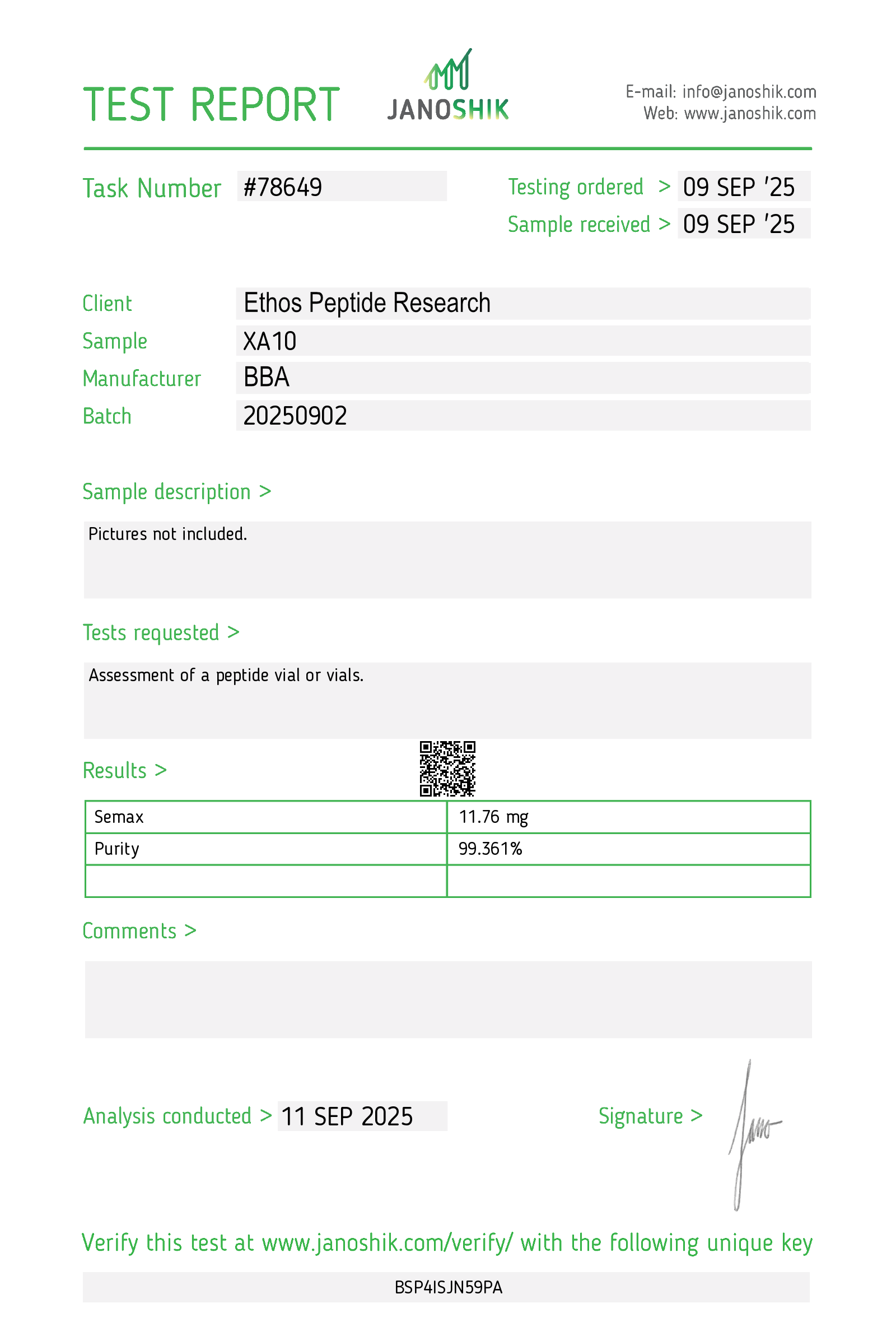
The short answer: a peptide certificate of analysis (COA) is a lab report for one specific batch. Read it in this order. Check that the lot number matches your vial. Confirm who ran the test, when, and how you can verify it. Find the identity result, usually a mass spectrometry match to the expected molecular weight. Then read purity and content as two separate numbers, because they measure different things.
What is a certificate of analysis for a research peptide?
A COA is the document that ties a physical vial to analytical data. In regulated drug manufacturing the format and test panel are set by specifications and pharmacopoeias. For research materials there is no single mandated layout, which is why COAs from different suppliers and labs look so different. Some are a single table with two numbers. Others include the chromatogram, the mass spectrum, method notes and a verification code.
That variety is exactly why it pays to read one carefully. The useful question is not “does a COA exist?” but “does this COA belong to this batch, and does it answer the questions I care about?”
Which fields should every peptide COA show?
- Lot or batch number. It should match the label on the vial in front of you. A COA for a different lot tells you about a different lot.
- Testing laboratory. Name, contact details, and ideally a way to verify the report directly with the lab, such as a unique key or QR code.
- Dates. When the sample was received and when the analysis was reported.
- Sample description. The compound name and labelled amount, plus appearance (for example, white lyophilized powder).
- Identity result. A confirmed match to the expected compound, with the method named.
- Purity result. A percentage, with the method named and, ideally, the chromatogram attached.
- Content or quantity. How much of the compound was measured in the vial, which is a different number from purity.
- Raw data. The chromatogram and mass spectrum, so you can see what the numbers were calculated from.
What does HPLC purity actually measure?
High-performance liquid chromatography separates the components of a sample. A UV detector records peaks as they come off the column, and purity is usually reported as the main peak’s area as a share of all integrated peak area. A clean result looks like one tall peak with very small neighbours.
Two limits are worth knowing. First, HPLC purity on its own does not prove identity: a sample can be 99% pure and still be the wrong molecule. Second, it only sees what the detector sees. Water, salts and bacterial endotoxin do not show up as peptide peaks, so they need other tests.
Small side peaks matter more than they look. In regulated generic peptide work, an FDA Office of Pharmaceutical Quality presentation summarises the expectation to identify each peptide-related impurity at 0.10% or more and to show no new peptide-related impurity above 0.5%, using orthogonal chromatography and UHPLC-HRMS/MS for peak identity. Research-grade COAs rarely go that deep, but it explains why a 99% figure still leaves room for real side products.
How does mass spectrometry confirm identity?
Mass spectrometry measures the mass-to-charge ratio of ions. Peptides often pick up several protons, so the spectrum may show the molecule at a fraction of its full mass. In one published analysis, semaglutide was identified by its characteristic peak at 1029.3 for the [M+4H]4+ ion, meaning four added protons (Ashraf et al., JMIR 2024).
To sanity-check an identity line, compare the observed mass against a reference value. For example, PubChem lists BPC-157 (CID 9941957) as C62H98N16O22 with a molecular weight of 1419.5 g/mol. A COA that names the compound but shows no mass data is asking you to take identity on trust.
Why are purity and net content different numbers?
A lyophilized peptide is rarely 100% peptide by weight. Peptides purified by reversed-phase HPLC are often isolated as trifluoroacetate (TFA) salts, and powders hold some residual water. So a vial can show high chromatographic purity while the mass of peptide in it differs from the label in either direction.
The counterion question is not just bookkeeping. Cornish et al. (1999) reported that TFA itself changed cell proliferation readouts in culture, which matters to anyone running in-vitro work with peptide salts.
What the evidence actually shows
Label claims versus measured values. Ashraf et al. (2024) made test purchases from 6 online vendors; 3 lyophilized semaglutide vials were delivered and tested once each by LC-MS, compendial sterility testing and a kinetic turbidimetric LAL endotoxin assay, against a genuine reference product. Vendor documentation claimed at least 99% purity. Measured purity was 7.70%, 8.97% and 14.37%, while measured semaglutide content was 28.56% to 38.69% above the labelled amount. Endotoxin was detected in all three samples, up to 8.95 EU/mg, and no viable microorganisms were found. The lesson for COA readers: a label is a claim, a measurement is data, and content and purity can move in opposite directions.
Counterions in cell culture. Cornish et al. (1999) studied fetal rat osteoblast cultures, articular chondrocytes and neonatal mouse calvariae. Over 24 hours, TFA at 10-8 to 10-7 M was associated with lower cell numbers and thymidine incorporation. When TFA and hydrochloride salts of amylin, amylin-(1-8) and calcitonin were compared in osteoblasts, proliferation readouts were consistently lower with the TFA salts. The authors concluded the issue is likely relevant to studies using purified peptides above 10-9 M, which is why the salt form on a COA is worth noting.
Endotoxin as a separate test. HPLC and mass spectrometry do not measure endotoxin. The FDA’s Pyrogen and Endotoxins Testing Q&A guidance covers gel-clot, photometric and kinetic test methods, which is the family of assays the JMIR authors used.
How this relates to research materials
A COA describes the batch at the time it was tested. What happens afterwards is about handling: research peptides are typically kept sealed at −20 °C and protected from light and moisture, and the COA date tells you how recent the snapshot is.
At ETHOS, every batch is 8X tested, meaning eight different tests, before it ships, and batch COAs are published and searchable by lot number in our public COA portal. Our quality testing page explains how our third-party testing works. If you want to practise on a real listing, the BPC-157 product page lists the PubChem reference identifiers and points to the batch COA, and the rest of the individual research peptides catalogue follows the same format.
What are the red flags on a peptide COA?
- No lot number, or a lot number that does not match the vial.
- No named lab, or no way to confirm the report with that lab.
- A purity percentage with no method and no chromatogram.
- “Pass” or “conforms” where a number should be.
- No identity result at all.
- The same report image reused across different sizes or dates.
Frequently asked questions
What HPLC purity should a peptide COA show?
There is no single research-grade standard. The percentage means more when it comes with the method, the chromatogram and a separate identity result. A high number with no raw data and no identity line tells you much less than it seems to.
Does HPLC purity prove the vial contains the right peptide?
No. HPLC shows how much of the UV signal sits in the main peak. Identity needs a separate method, usually mass spectrometry, matched to the expected molecular weight.
Why might measured content differ from the label?
Powders contain counterions such as trifluoroacetate and some residual water, and fill amounts vary. Published testing has found content above label alongside very low purity, so the two numbers need reading separately.
How do I find the COA for an ETHOS batch?
Take the lot number from your vial label and search it in the ETHOS public COA portal at ethos-support.com. Each batch has its own report.
Research use only. ETHOS products are sold strictly for laboratory research and are not for human or veterinary use. This article describes published analytical work and how to read documentation; it is not guidance on use.
Frequently asked questions
What HPLC purity should a peptide COA show?
There is no single research-grade standard. The percentage means more when it comes with the method, the chromatogram and a separate identity result. A high number with no raw data and no identity line tells you much less than it seems to.
Does HPLC purity prove the vial contains the right peptide?
No. HPLC shows how much of the UV signal sits in the main peak. Identity needs a separate method, usually mass spectrometry, matched to the expected molecular weight.
Why might measured content differ from the label?
Powders contain counterions such as trifluoroacetate and some residual water, and fill amounts vary. Published testing has found content above label alongside very low purity, so the two numbers need reading separately.
How do I find the COA for an ETHOS batch?
Take the lot number from your vial label and search it in the ETHOS public COA portal at ethos-support.com. Each batch has its own report.