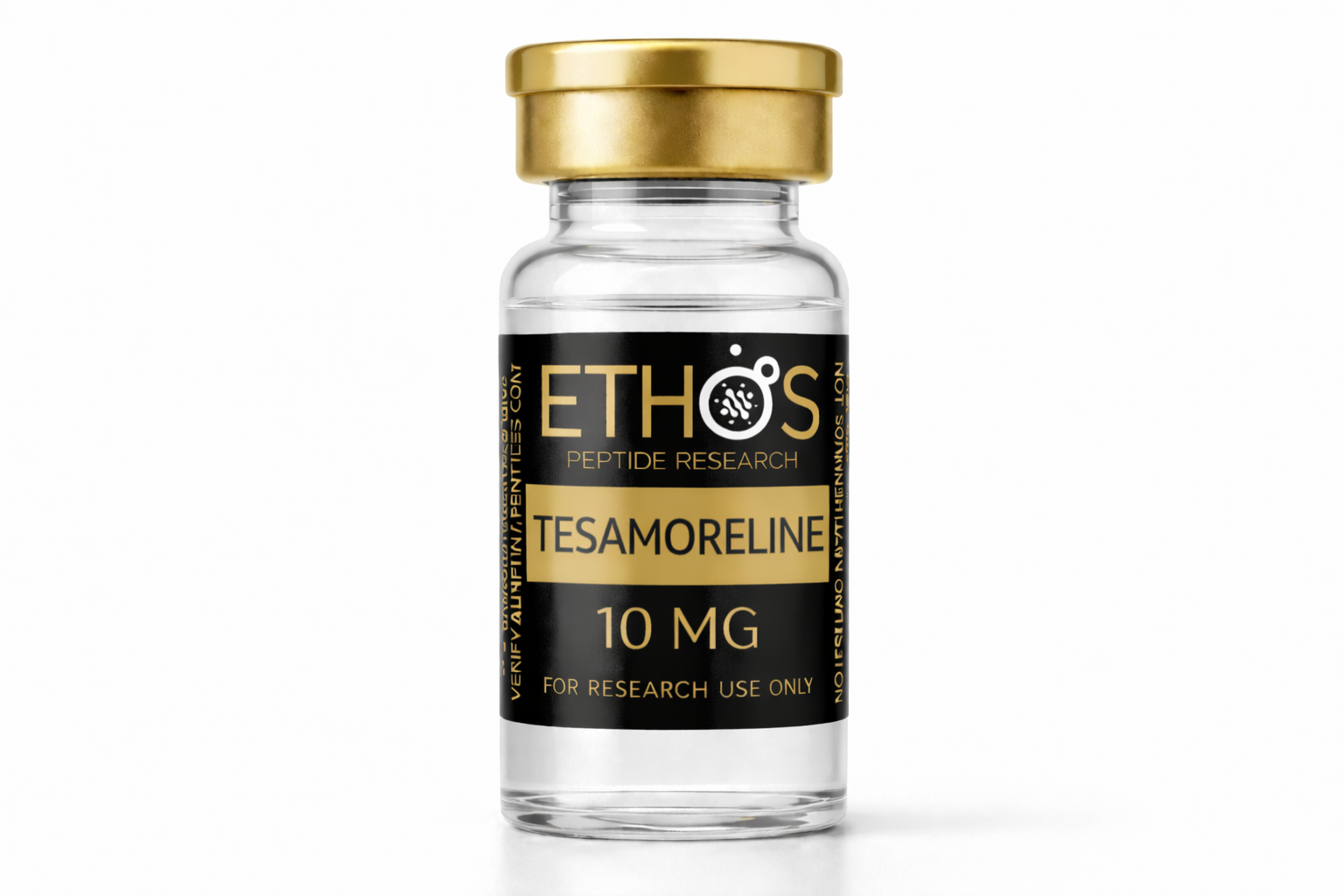
Tesamorelin
$50.00
Tesamorelin is a synthetic growth hormone-releasing hormone (GHRH) analog peptide. 99%+ purity, third-party tested. Fast, discreet shipping.

Tesamorelin Research Peptide
Tesamorelin is a synthetic peptide analog of human growth hormone–releasing hormone (GHRH), used in scientific studies to investigate its effects on hormone regulation and metabolism.
Tesamorelin (Research Use Only)
Chemical Name: Tesamorelin acetate
Synonyms: TH9507, Egrifta, Egrifta SV
CAS Number: 218949-48-5
Sequence: Tyr–Ala–Asp–Ala–Ile–Phe–Thr–Asn–Ser–Tyr–Arg–Lys–Val–Leu–Gly–Gln–Leu–Ser–Ala–Arg–Lys–Leu–Leu–Gln–Asp–Ile–Met–Ser–Arg–Gln–Gln–Gly–Glu–Ser–Asn–Gln–Glu–Arg–Gly–Ala–Arg–Ala–Arg–Leu–NH₂
Molecular Formula: C221H366N72O67S
Molecular Weight: 5135.86 g/mol (free base)
Molecular Weight (acetate form): ≈5579 g/mol
Description
Tesamorelin is a synthetic analog of growth hormone–releasing hormone (GHRH) designed to stimulate natural growth hormone (GH) secretion and elevate insulin-like growth factor 1 (IGF-1) levels. This peptide is frequently studied for its effects on visceral adipose tissue (VAT) reduction and lipid metabolism, particularly in models involving HIV-associated lipodystrophy.
Research Applications
- Investigated for body composition modulation and targeted lipolytic action.
- Studied in metabolic and endocrine research related to GH and IGF-1 activity.
- Demonstrated reduction in visceral and liver fat without adverse glucose metabolism effects.
- 52-week studies show sustained VAT reduction (~18%) and improved lipid levels.
Key Research & Reports
Mechanism of Action
Tesamorelin binds to the pituitary GHRH receptor, enhancing the pulsatile release of GH. The increased GH then promotes hepatic IGF-1 synthesis, initiating anabolic and lipolytic pathways that improve body composition and fat metabolism profile in research subjects.
Safety and Handling
Tesamorelin demonstrates a strong safety profile in controlled research settings. Reported transient effects include localized injection site reactions and temporary fluid retention. Store lyophilized vials at −20°C. Reconstitute only prior to laboratory use.
Disclaimer
For laboratory research use only. Not for human consumption, medical treatment, or veterinary applications. All data provided is for educational and informational purposes specific to research contexts.
| Weight | .2 lbs |
|---|---|
| Dimensions | .5 × .5 × 1 in |
| TesaMG | 10mg |
Related products
-
Individual Peptides
BPC-157
$26.00 Select options This product has multiple variants. The options may be chosen on the product page -
 Individual Peptides
CAGRI
$82.00 Select options This product has multiple variants. The options may be chosen on the product page -
 Cognitive Enhancement
Selank
$43.00 Select options This product has multiple variants. The options may be chosen on the product page -
 Individual Peptides
Aicar
$49.00 Select options This product has multiple variants. The options may be chosen on the product page