
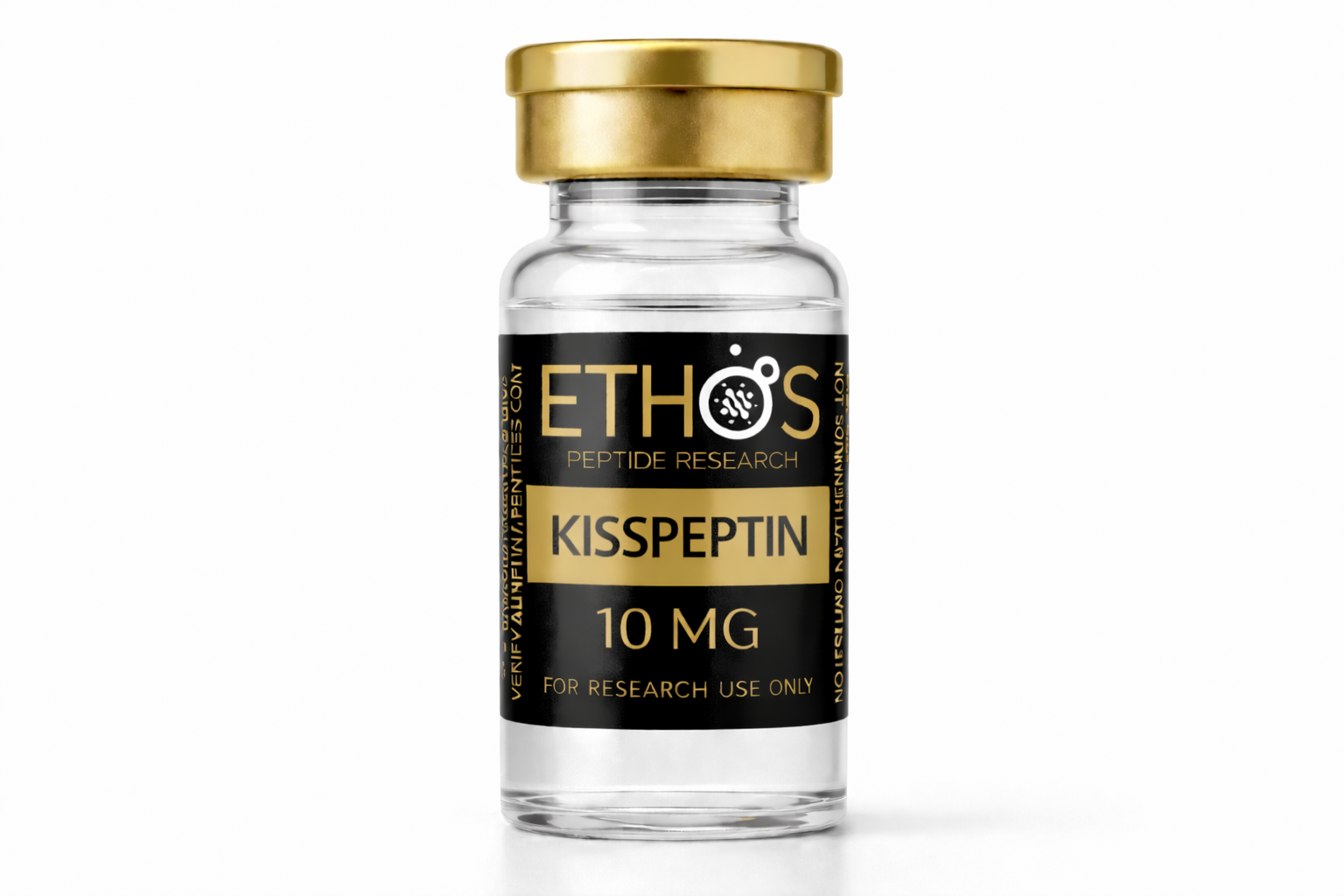


Kisspeptin-10 Peptide
Kisspeptin-10 is a synthetic decapeptide fragment of the endogenous KISS1 (metastin) peptide, widely investigated as a potent agonist of the G protein–coupled kisspeptin receptor KISS1R (GPR54).
This peptide represents the minimal C-terminal sequence required for full intrinsic kisspeptin bioactivity and is frequently used as a research tool in reproductive endocrinology, oncology, and neuroendocrine signaling studies.
Identity
- Name: Kisspeptin-10 (Kp-10)
- Synonyms: Metastin(45–54), KISS1(112–121), KP-10 peptide, KISS1-derived decapeptide, KISS1R agonist.
- CAS Number (human): 374675-21-5
- Sequence (one-letter): YNWNSFGLRF
- Sequence (three-letter): Tyr-Asn-Trp-Asn-Ser-Phe-Gly-Leu-Arg-Phe-NH2
- Molecular formula: C63H83N17O14
- Molecular weight: ~1302.4–1302.5 g/mol
- Appearance: White to off-white lyophilized powder
Peptide Characteristics
- Kisspeptin-10 is a C-terminally amidated decapeptide derived from the longer KISS1 gene product (e.g., kisspeptin-54 / metastin), retaining full receptor binding and signaling efficacy at KISS1R.
- The KP-10 sequence represents the minimal active motif required to activate GPR54/KISS1R and is widely used to probe kisspeptin signaling in vitro and in vivo.
- Belongs to the Arg-Phe amide peptide family, characterized by a conserved C-terminal RF-NH2 motif.
Research Background
- Kisspeptin-10 is used as a tool compound to study regulation of the hypothalamic–pituitary–gonadal axis, where it potently stimulates GnRH neurons and increases downstream gonadotropin (e.g., LH) secretion.
- The peptide has also been explored for its metastasis-suppressing properties and its roles in trophoblast invasion, tumor biology, and broader neuroendocrine signaling pathways.
- Binding of Kisspeptin-10 to KISS1R activates intracellular cascades including phospholipase C, inositol trisphosphate signaling, intracellular Ca2+ mobilization, and MAPK pathway activation.
Suggested Handling
- Supplied as a high-purity research peptide intended strictly for laboratory research use; not approved for human or veterinary injection, clinical, diagnostic, or therapeutic applications.
- Store lyophilized peptide at low temperature (typically around −20 °C), protected from light and moisture; reconstituted solutions should be handled using appropriate aseptic technique and stored according to internal laboratory SOPs.
Related products
-
 Cognitive Enhancement
BAC Water
Price range: $3.49 through $7.00 Select options This product has multiple variants. The options may be chosen on the product page -
 Growth Hormone Peptides
Tesamorelin
$50.00 Select options This product has multiple variants. The options may be chosen on the product page -
 Individual Peptides
CAGRI
$82.00 Select options This product has multiple variants. The options may be chosen on the product page -
 Individual Peptides
TB500
$46.00 Select options This product has multiple variants. The options may be chosen on the product page


