

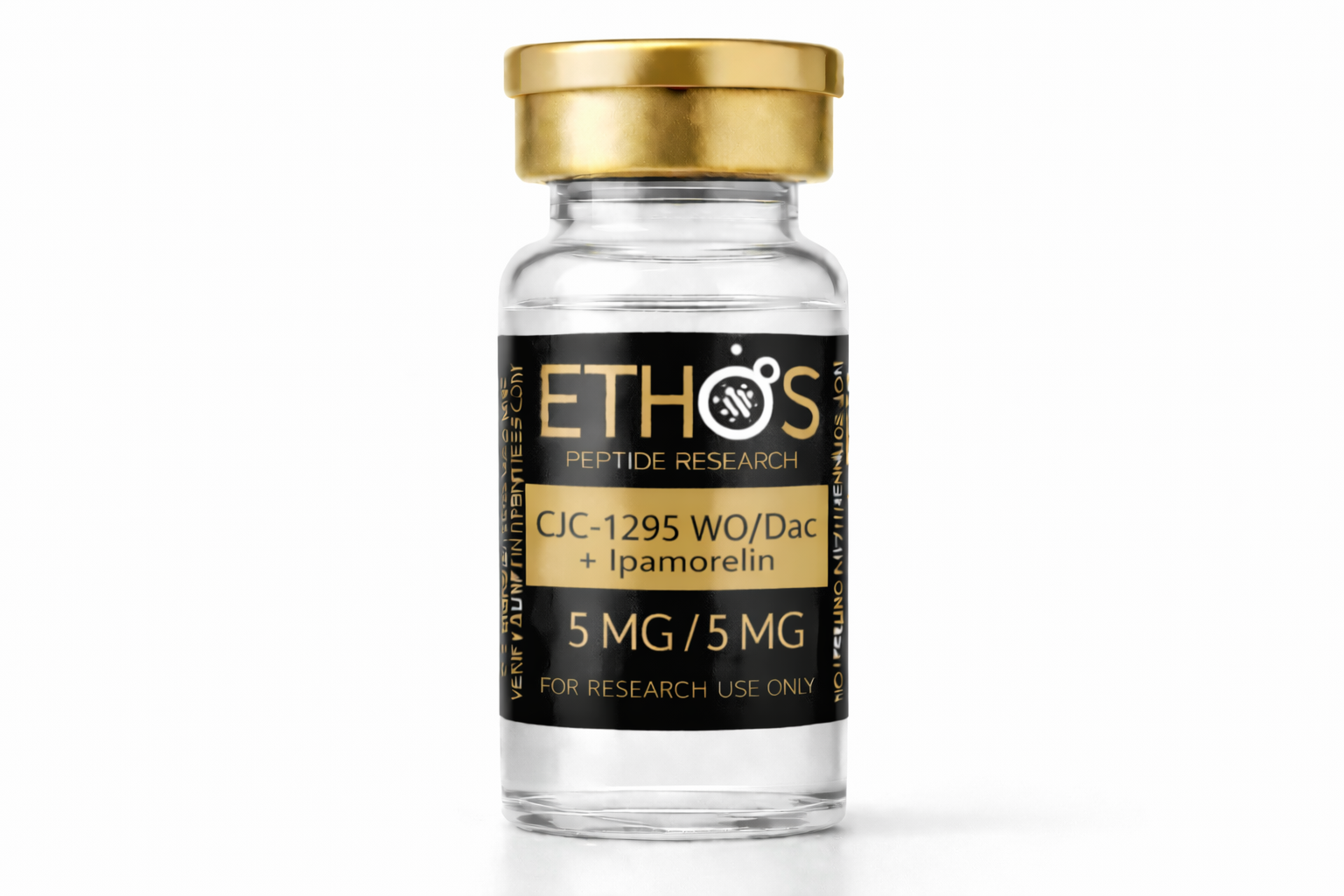
CJC-1295 WO/Dac 5mg + Ipamorelin 5mg
$55.00


CJC-1295 without DAC 5mg + Ipamorelin 5mg (Research Use Only)
CJC-1295 without DAC
CAS Number: 863288-34-0
Molecular Formula: C152H252N44O42
Molecular Weight: 3367.9 g/mol
Sequence: Tyr-Ala-Asp-Ala-Ile-Phe-Thr-Gln-Ser-Tyr-Arg-Lys-Val-Leu-Gly-Gln-Leu-Ser-Ala-Arg-Lys-Leu-Leu-Gln-Asp-Ile-Met-Ser-Arg-Gln
Ipamorelin
CAS Number: 170851-70-4
Molecular Formula: C38H49N9O5
Molecular Weight: 711.85 g/mol
Sequence: Aib-His-D-2-Nal-D-Phe-Lys-NH2
Appearance: White to off-white lyophilized powders
Storage: Store lyophilized powders at 2–8°C, protect from moisture and light
Form: Lyophilized solid, soluble in water or DMSO
Description
This blend combines CJC-1295 (without DAC), a modified 29-amino acid peptide analog of growth hormone releasing hormone (GHRH), and Ipamorelin, a selective growth hormone secretagogue. Together, these peptides are investigated for their synergistic, pulsatile stimulation of endogenous growth hormone (GH) release in research settings—CJC-1295 WO/DAC provides physiological GH pulse patterns, while Ipamorelin delivers rapid, intense GH secretion. As a combination, they are used to explore enhanced anabolic, metabolic, and recovery effects.
(CJC-1295 Wikipedia)
(CJC-1295 WO/DAC PubChem)
(Ipamorelin PubChem)
Research Applications
- Studies on synergistic growth hormone release from dual secretagogues
- Research on anabolic and muscle regeneration support
- Exploration of fat loss and recovery mechanisms
- Circadian GH rhythm and pulsatility studies
- Potential roles in wound healing and tissue repair
Key References
Mechanism of Action
CJC-1295 WO/DAC is a GHRH analog optimized for pulse-like, physiologic GH secretion, while Ipamorelin is a GH secretagogue acting via the ghrelin receptor. Their combination may confer both baseline (sustained) and spike (acute) GH increases in research models, more closely mimicking natural GH release than single agents alone.
Safety and Handling
Store lyophilized peptides at 2–8°C, protected from light and moisture. Reconstitute immediately prior to research use. Preclinical safety studies indicate good tolerance; always use aseptic technique.
Disclaimer
For laboratory research use only. Not for human, medical, veterinary, or diagnostic use. All information provided for scientific and educational purposes only.
| Weight | N/A |
|---|---|
| Dimensions | N/A |
| CJCWODACIPAMG | 10mg |
Related products
-
 Individual Peptides
Mots-C
$58.00 Select options This product has multiple variants. The options may be chosen on the product page -
 Individual Peptides
Aicar
$49.00 Select options This product has multiple variants. The options may be chosen on the product page -
 Individual Peptides
Thymosin Alpha-1
$65.00 Select options This product has multiple variants. The options may be chosen on the product page -
 Individual Peptides
TB500
$46.00 Select options This product has multiple variants. The options may be chosen on the product page


