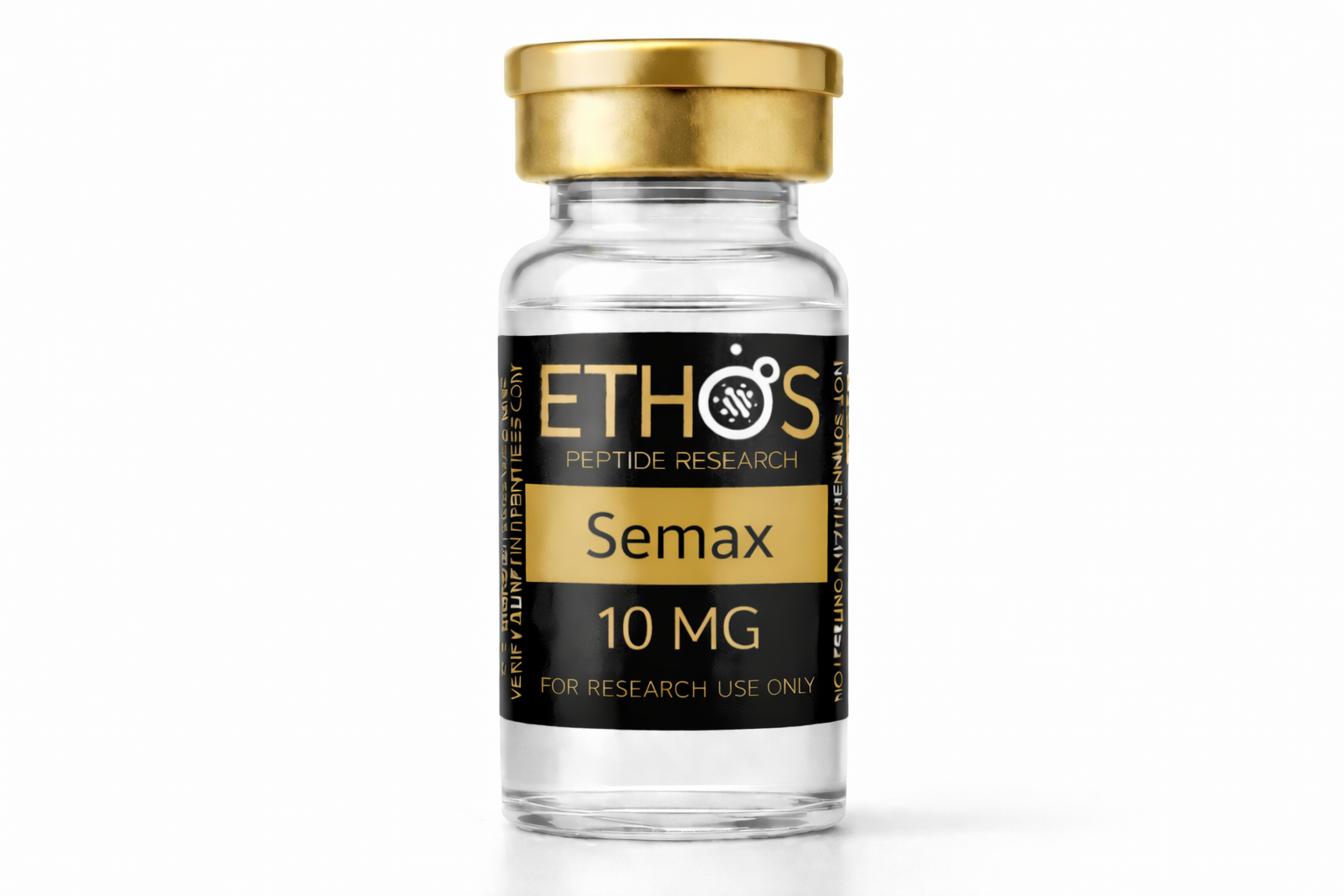
Semax Peptide: A Complete Scientific Guide for Researchers
Boost research with pure Semax. Ethos

Boost research with pure Semax. Ethos Peptide provides molecular tools to study neuroplasticity, resilience, and protection.
1. Introduction to Semax Research
2. The Evolution of Heptapeptides: Historical Context
3. Molecular Chemistry and Biochemical Stability
4. Mechanism of Action: The BDNF and TrkB Pathway
5. Neuroplasticity and Synaptic Strengthening
6. Investigating Memory Formation and Long-Term Potentiation LTP
7. Stress Adaptation and HPA Axis Modulation
8. Dopaminergic and Serotonergic Regulation Research
9. Neuroprotection: Combating Oxidative Stress and Hypoxia
10. Cellular Longevity and Anti-Senescence Studies
11. Comparative Analysis: Semax vs. N-Acetyl Semax vs. Amidate
12. The Synergy of Semax and Selank in Behavioral Models
13. Pharmacokinetics and Olfactory Delivery Research
14. Laboratory Protocols: Administration and Storage
15. Safety Profile and Long-Term Experimental Findings
16. Why Quality Standards Matter in Peptide Synthesis
17. Future Horizons in Peptide-Based Neuroscience
18. FAQs
19. Conclusion
Semax is a synthetic heptapeptide that represents a breakthrough in modern neuroscience. It is derived from a fragment of the Adrenocorticotropic hormone (ACTH). In contrast, Semax lacks endocrine activity, even though the full ACTH hormone governs stress responses and metabolic functions. This makes it a highly specific tool for investigating the central nervous system without systemic hormonal interference.
Researchers primarily use Semax to study cognitive optimization and cellular resilience. Its unique ability to influence gene expression related to nerve growth makes it a cornerstone of contemporary peptide research. Ethos Peptide Research is committed to providing high-purity Semax to assist the scientific community in mapping these complex neurological pathways.
The development of Semax began in the 1980s at the Institute of Molecular Genetics (Russian Academy of Sciences). Consequently, scientists sought a compound to prevent neuronal death during stroke and hypoxic events in experimental models.
The research team discovered that small fragments of ACTH possessed potent neuro-restorative properties. By stabilizing these fragments with specific amino acid sequences, they created Semax. Furthermore, since its inception, the peptide has evolved from a specialized investigative tool into a globally recognized subject of neuro-regenerative research.
The chemical sequence of Semax is the specific arrangement classifies it as a heptapeptide (consisting of seven amino acids).
A key breakthrough in its design was the addition of the Pro-Gly-Pro (PGP) sequence. Consequently, the PGP sequence grants Semax significant resistance to enzymatic breakdown, whereas naturally occurring peptides often degrade within minutes due to proteolytic enzymes. This stability allows for extended observation periods in laboratory settings, providing researchers with more consistent and reliable data.
One of the most significant areas of Semax research involves its impact on Brain-Derived Neurotrophic Factor (BDNF). BDNF is a protein essential for the growth, maintenance, and survival of neurons.
In research models, Semax has been shown to increase the mRNA expression of BDNF. Subsequently, this protein binds to TrkB receptors and triggers a cascade of intracellular signals that strengthen synaptic connections. Understanding this pathway is vital for research into reversing cognitive decline and facilitating brain repair.
Neuroplasticity is the biological system’s ability to reorganize itself by forming new neural connections. Semax supports this through synaptogenesis.The creation of new synapses.
Moreover, researchers observe how quickly subjects adapt to new experimental tasks after they introduce Semax. By increasing the density of synaptic markers, the peptide allows researchers to explore the upper limits of biological learning and adaptation.
Long-Term Potentiation (LTP) is the persistent strengthening of synapses based on recent patterns of activity. It is widely considered the cellular mechanism behind memory storage. Semax has been documented to enhance LTP in the hippocampus, the brain’s primary memory center.
Researchers observe that models utilizing Semax can process and recall large datasets with higher efficiency. This research provides a scientific foundation for understanding how to enhance “working memory” and executive processing in biological systems.
Chronic stress triggers high levels of cortisol, which can lead to neuronal atrophy. Semax acts as an experimental adaptogenby modulating the Hypothalamic-Pituitary-Adrenal (HPA) axis.
Furthermore, Semax maintains cognitive stability in laboratory subjects even during exposure to high-pressure stimuli. Researchers use this data to study how to prevent “burnout” and stress-induced cognitive failure at a molecular level.
In addition, Semax regulates dopamine and serotonin levels without depleting natural reserves. Specifically, dopamine drives motivation and reward, whereas serotonin stabilizes mood and emotional resilience.
Research indicates that Semax optimizes dopamine release in the prefrontal cortex. This makes it a valuable tool for studying executive function, focus, and behavioral organization in ADHD-like experimental models.
Oxygen deprivation (hypoxia) is lethal to neurons. Semax was originally researched for its ability to keep brain cells viable even under low-oxygen conditions.
It works by reducing oxidative stress and mitigatin Glutamate excitotoxicity (a process where excessive signaling leads to cell death). Because of these neuroprotective effects, Semax is a gold standard in research regarding stroke recovery and nerve fiber repair.
As biological systems age, neuronal firing speed typically decreases. Semax is studied for its ability to protect neurons from age-related inflammation and decay.
Ethos Peptide Research focuses on how Semax can be integrated into longevity protocols. By studying its interaction with senescent cells, researchers can explore ways to maintain peak cellular functionality over longer lifespans.
For precise research, choosing the correct variant is essential:
Standard Semax: Ideal for acute studies and basic neurological mapping.
N-Acetyl Semax: Includes an acetyl group that allows the molecule to cross the Blood-Brain Barrier (BBB) more efficiently.
N-Acetyl Semax Amidate: The most advanced research variant. It offers maximum stability against enzymatic breakdown and a longer half-life in experimental settings.

Researchers often study Semax in conjunction with Selank, another Russian-developed peptide. While Semax investigates focus and performance, Selank is used to study anxiety reduction and relaxation. Their synergy allows for the investigation of a perfectly balanced biological state, high productivity combined with emotional stability.
Semax is most frequently studied via intranasal administration. This delivery route allows the peptide to travel along the olfactory nerve, bypassing the digestive system and entering the brain directly. In laboratory models, physiological changes are typically observed within 15 to 30 minutes of application.
To ensure data accuracy, researchers must follow strict protocols:
Administration: Typically subcutaneous or intranasal (nasal spray) in experimental subjects.
Storage: Lyophilized powder or reconstituted solution must be stored between 2°C and 8°C (refrigerated). Heat and light break down peptide bonds, rendering the research material ineffective.
Handling:Always use sterile, bacteriostatic water for reconstitution to prevent microbial contamination.
With over three decades of clinical data, Semax has established a very stable safety profile. It is non-toxic and does not appear to cause receptor desensitization or dependency in long-term studies. Minor localized reactions, such as transient nasal tingling, are the only frequently documented effects.
Impure peptides can introduce variables that ruin research data. Ethos Peptide Research subjects every batch to Third-Party HPLC and MS Testing. We guarantee a purity level of 99% or higher, ensuring that your laboratory results are both accurate and repeatable.
The future of peptide science is expanding toward neurodegenerative disease prevention. Researchers are currently investigating Semax’s role in early-stage Alzheimer’s and Parkinson’s models. New delivery technologies, such as sublingual tablets or advanced transdermal patches, are also under investigation.
Q: What is the half-life of Semax in research models?
Most observations show physiological activity for 4 to 6 hours after administration.
Q: Does it interfere with other experimental compounds?
Semax is generally compatible with other nootropic research subjects, but synergy must be carefully monitored.
Q: What is the primary research goal of Semax?
Investigating neuroprotection, BDNF upregulation, and synaptic strengthening.
Semax is a pinnacle of modern peptide engineering. Its multifaceted ability to protect neurons and stimulate growth factors like BDNF makes it an invaluable asset in neurological discovery.
Ethos Peptide Research is proud to be your trusted supplier, providing the molecular foundations that help researchers push the boundaries of what is possible in brain science.
This product is intended for research purposes only. Ethos Peptide Research does not condone the use of this product outside of controlled scientific settings.
Visit Ethos Peptide Research today to secure the highest purity Semax for your next study. Elevate your data and discover the future of neuroscience.
SemaxPeptide, Neuroplasticity, EthosPeptides
Boost research with pure Semax. Ethos
Advance your research with high-purity Thymosin
Tesamorelin 10mg boosts GH & cuts
Explore how GLP-R peptides boost metabolic
GLP-S peptide revolutionizes metabolism. It boosts

Buy high purity Cagri 5mg at
Boost research with pure Semax. Ethos Peptide provides molecular tools to study neuroplasticity, resilience, and protection.
Advance your research with high-purity Thymosin Alpha-1. Ethos Peptide Research provides the molecular tools for biological exploration.
Tesamorelin 10mg boosts GH & cuts visceral fat by 15%. Research shows lean muscle gain & metabolism support.
Explore how GLP-R peptides boost metabolic health. Ethos Peptide Research offers high-purity peptides for anti-aging. Start your goals today.
GLP-S peptide revolutionizes metabolism. It boosts cellular health, aids weight loss, and improves research. Study its impact and dosage now.
Buy high purity Cagri 5mg at Ethos Peptide Research for advanced metabolic studies and enjoy fast shipping and guaranteed quality.
Sign up and keep up with our Newsletter. Get 12% OFF on all products.